The framework
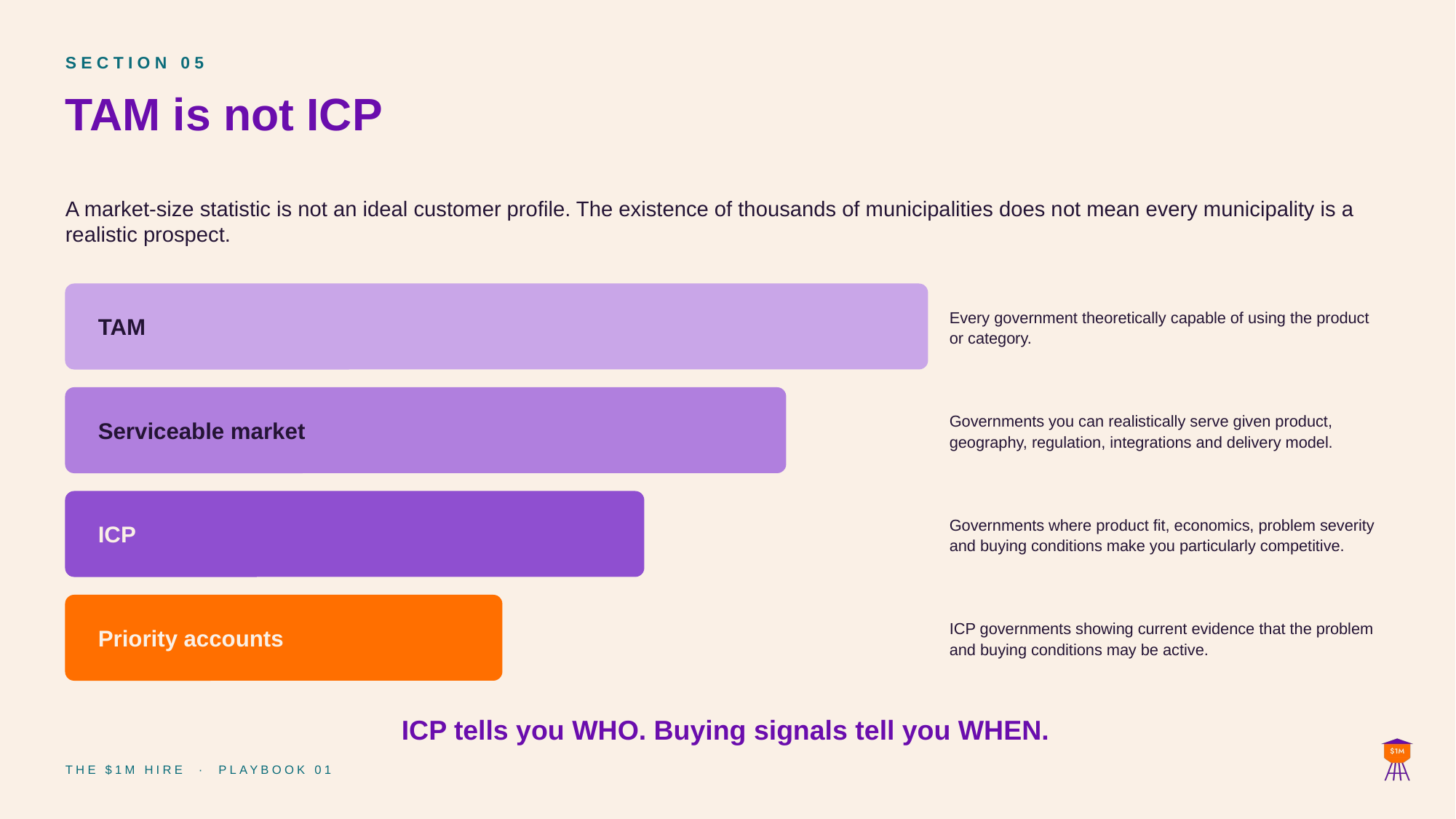
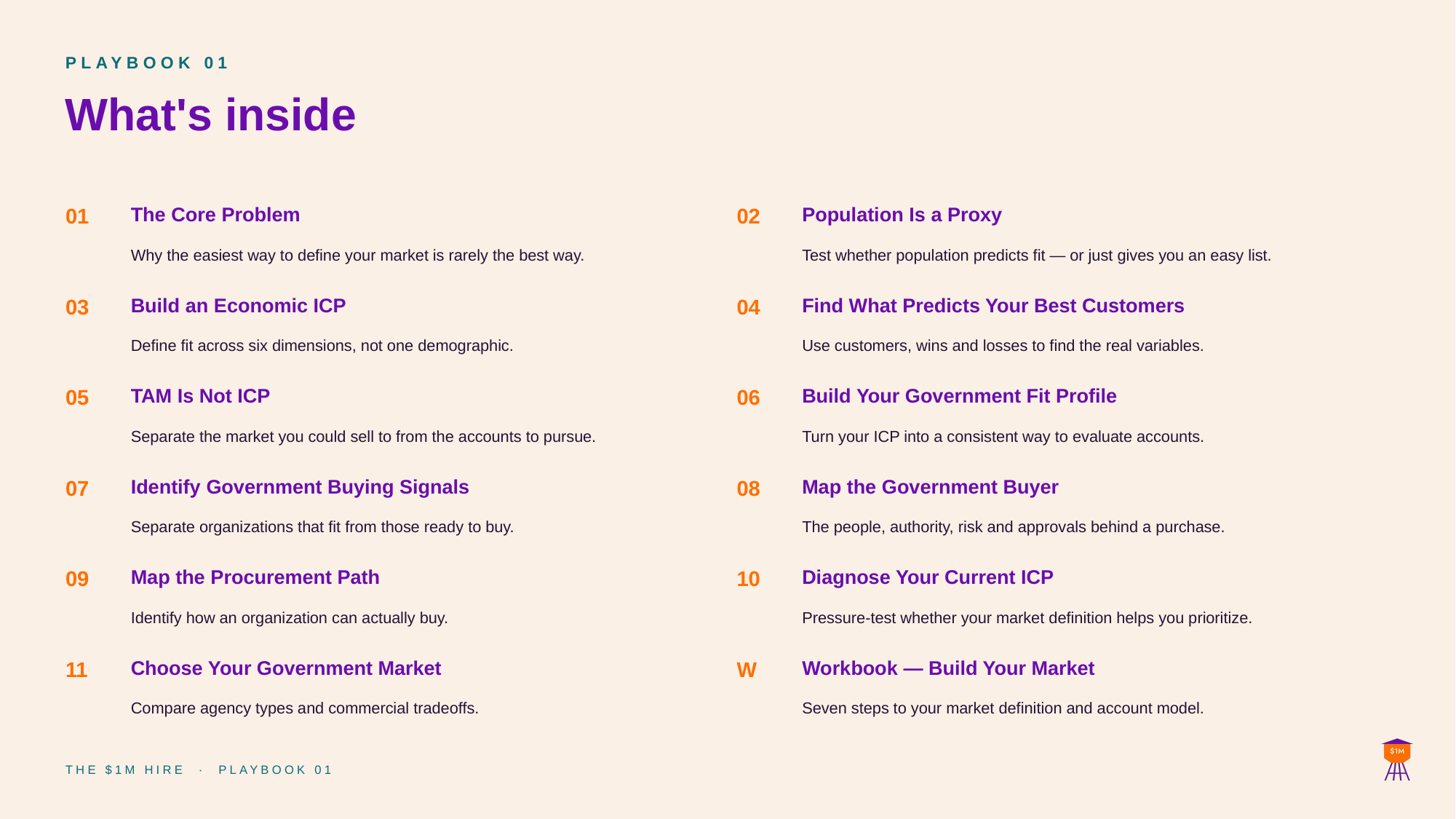
Eleven sections on defining a GovTech market — why population is only a proxy, what budget reveals, how to find the variable that actually predicts your best customers, and how agency type changes the entire sale.
The $1M Hire · GovTech GTM system
A six-playbook system for early-stage GovTech founders, built in the order the questions need answering. Two are live: which government market you're actually building for, and why that market should care enough to engage.
Playbooks 01 and 02 available now · PDF · Instant download
The $1M job description
Good luck finding the salesperson with the right industry experience for your niche market who can also:
Then carry a $1M quota.
That's the job of a CRO, a CMO and a Sales Operations team — at the price tag of a mid-market AE. Nobody who can actually do it will say yes.
The math nobody runs
Every month of runway you spend schlepping through deals one at a time — without a defined market, a qualified account list or a repeatable process underneath you — is cash you don't get back. Your first rep produces their first meaningful data point with a quarter of the runway left, and too often that data point is "we picked the wrong segment." The market definition is the cheapest thing to get right, the most expensive thing to get wrong, and the only one you can fix in a weekend.
The system
Each one builds the infrastructure the next one assumes. Buy them as they release, or start wherever your constraint is.
Who should we actually sell to? ICP frameworks, buyer and procurement mapping, observable buying signals and a tiered account model. 55 pages.
Why should this market care, and how will you create a repeatable reason to engage? Problem and outcome statements, positioning, role-based messaging, proof and channel experiments. 43 pages.
How do we turn interest into qualified, winnable opportunities?
How do we make revenue repeatable and measurable?
How do we deliver what Sales sold?
How do we retain, prove value and expand?
Playbook 01 · What you get
Eleven sections on defining a GovTech market — why population is only a proxy, what budget reveals, how to find the variable that actually predicts your best customers, and how agency type changes the entire sale.
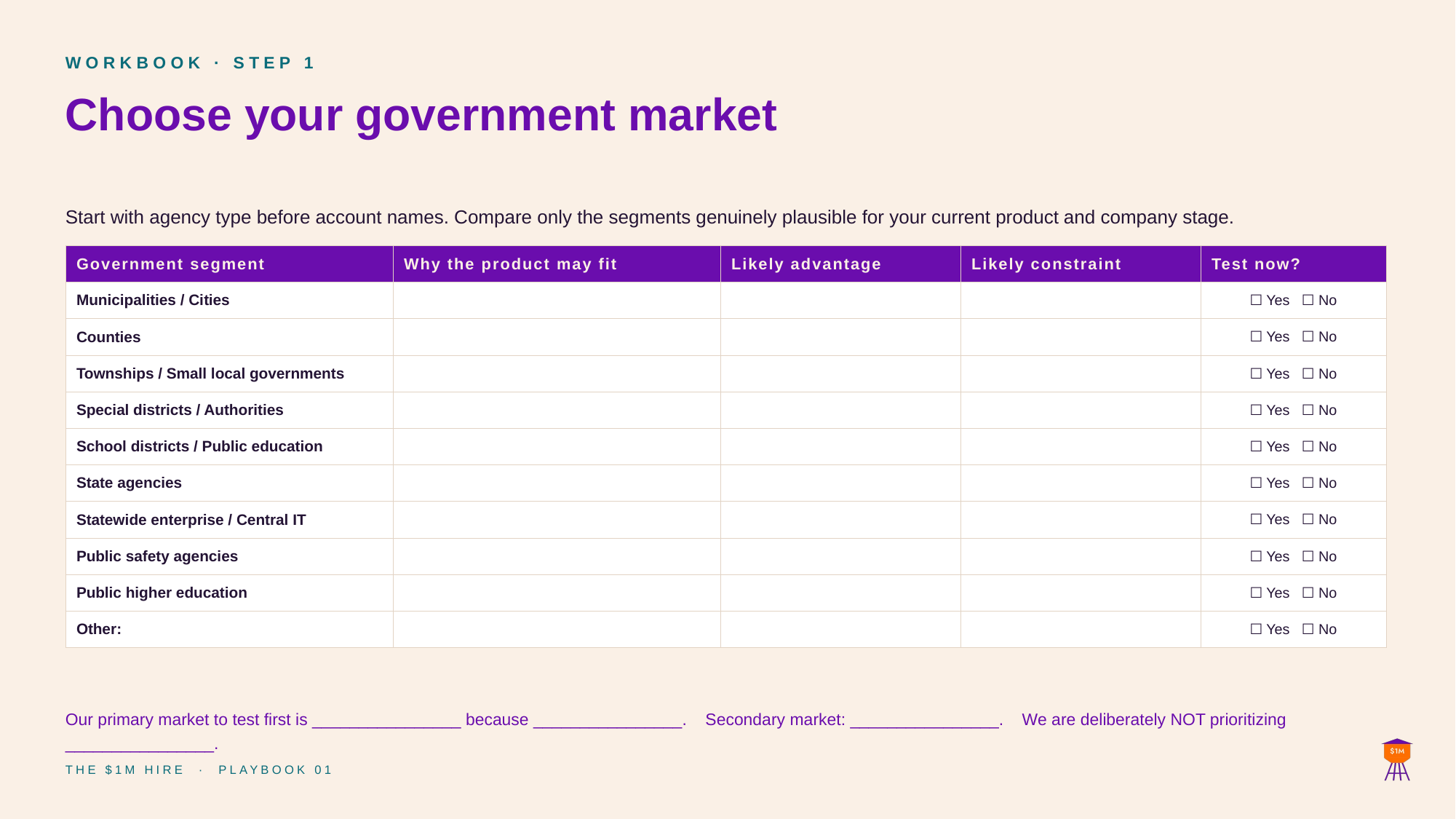
Seven steps that turn the thinking into decisions. Worksheets, not homework. You finish with a market definition, a buyer map, a buying-signal map and a tiered account list.
A single page your Founder, Sales, Marketing and Product teams can use together — and that answers the board question "which market are we going after, and why?"
Outcomes
No email required
The preview covers the problem, the six-playbook system, two of the frameworks and a workbook page.
Open the free previewPlaybook 02 · What you get
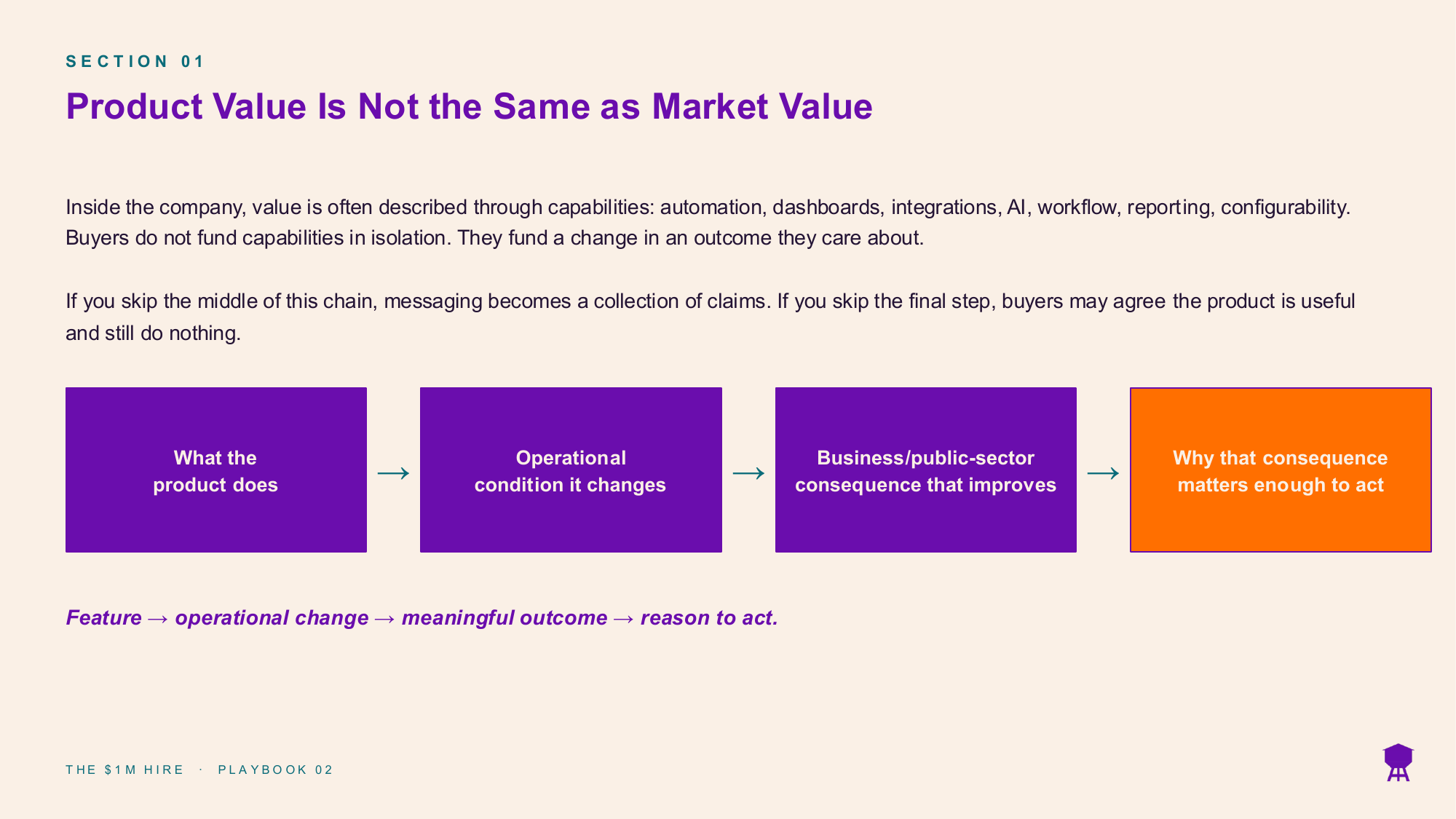
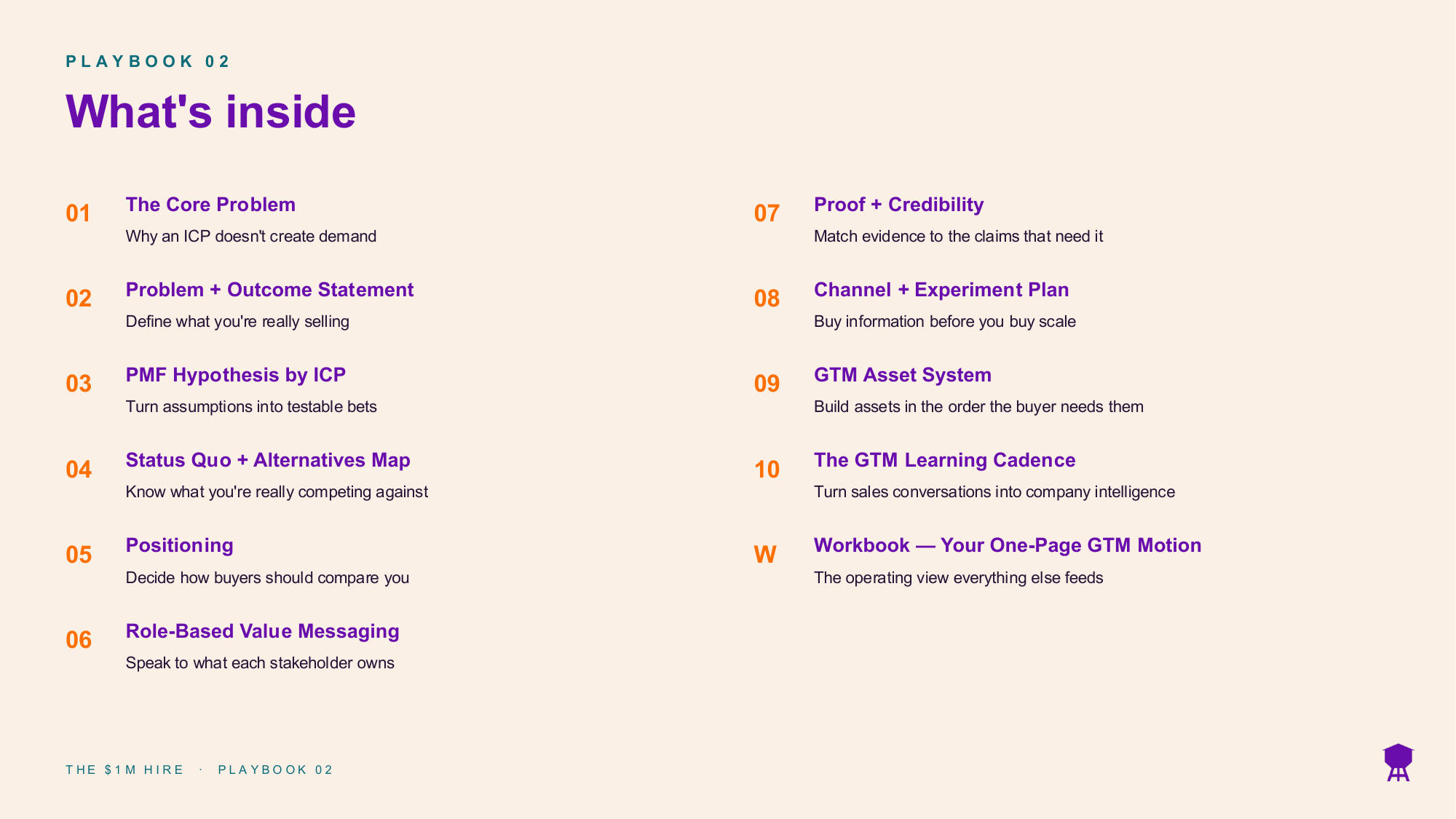
Why an ICP doesn't create demand, how to write a problem statement the buyer owns, what you're really competing against, how to position against the real alternative, and how to choose channels from buyer behavior rather than another SaaS company's playbook.
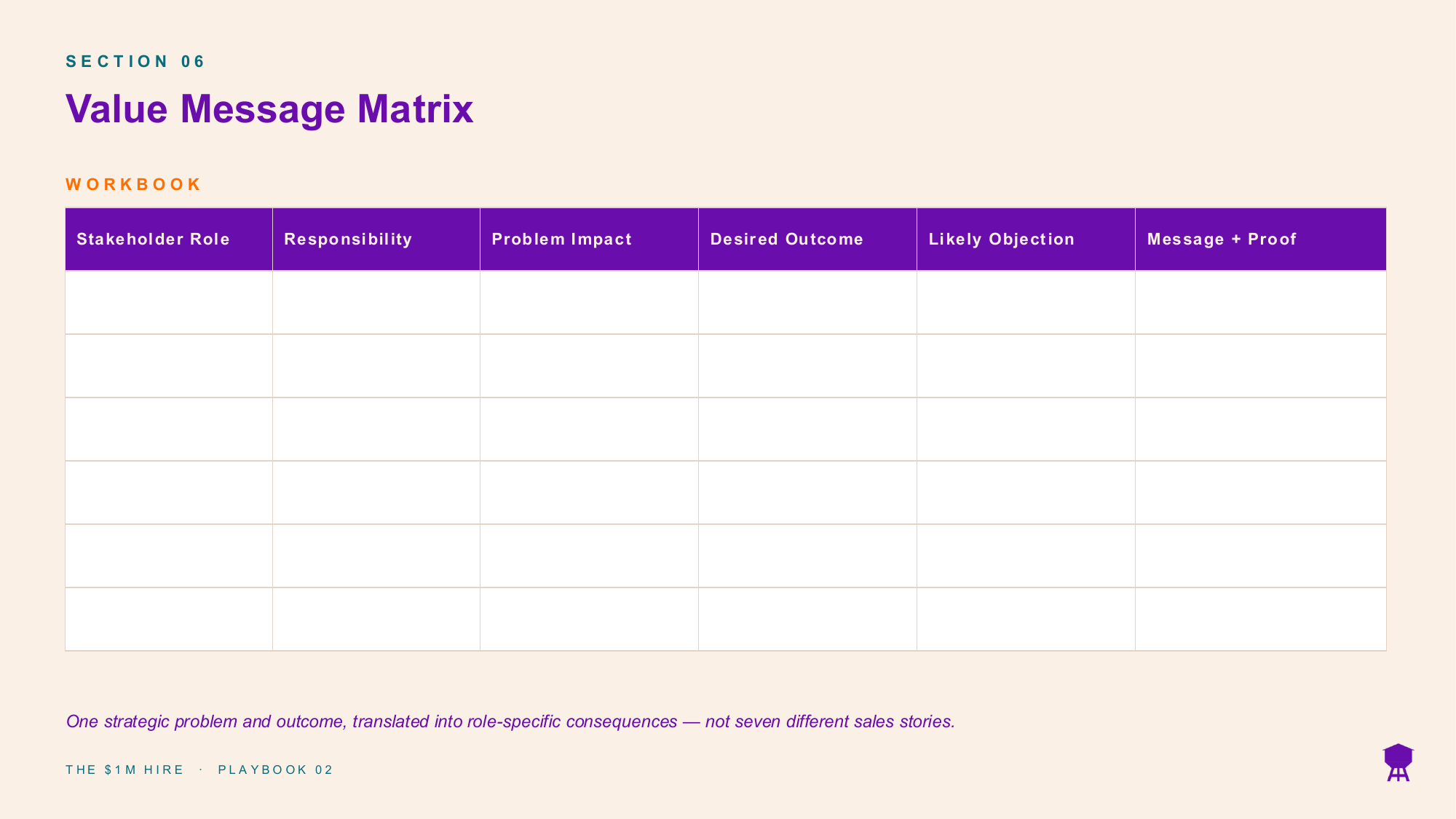
Fill-in templates for the problem and outcome statements, the PMF hypothesis, the alternatives map, the positioning statement, a role-based value message matrix, a proof inventory, an experiment plan and a GTM learning log.
Fourteen lines that hold the whole argument: the problem you lead with, the outcome you sell, why this ICP cares now, the change trigger, positioning, value by role, strongest proof, channel hypotheses and who owns the learning.
Playbook 02 · Outcomes
No email required
The preview covers the core problem, the value chain, the Founding AE Trap, the seven-step build and a workbook page.
Open the free preview
Who made this
I'm Megan Gonyo. Seven years in the GovTech vertical across sales, solutions engineering, GTM strategy, revenue infrastructure and implementation — at OpenGov, Oracle Local Government and Gravity (now ClearGov).
At Gravity I helped move a transactional sales motion toward consultative enterprise selling, grew average selling price by more than 300% and finished #2 among sales reps in 2025. At Oracle Local Government I generated 5× pipeline-to-quota in a 100% new-logo role. At OpenGov I recognized product-market fit in a state agency RFP that had been ruled outside our ICP, convinced the CEO to pursue it, and closed the largest product-suite deal in company history.
I've also built the unglamorous parts inside early-stage companies: ICP and segmentation, buyer personas, pricing logic, CRM architecture, targeting frameworks, outbound campaigns and the GTM infrastructure required to take a new product to market.
Playbook 01
55-page PDF. Who should we actually sell to?
Each is less than one day of the hire you're considering. Playbooks 03–06 release next; buyers get them first, at a discount.
Questions
Most GovTech ICPs are a population range with a job title attached. Here's the test from Section 10: if your reps can't explain why one 50,000-person city is a better prospect than another, the ICP isn't doing its job.
It's the right time. Step 3 of the workbook has a path for pre-revenue companies using design partners, pilots and late-stage opportunities. Doing this before you hire is the entire point.
Templates give you blanks. This gives you the reasoning behind the blanks — why budget may predict fit better than population, how agency type changes the buying committee, which signals mean an account can actually buy — and then the worksheets.
Section 11 compares nine agency types — municipalities, counties, townships, special districts, school districts, state agencies, statewide enterprise and central IT, public safety and public higher education — across sales complexity, contract potential, procurement environment and implementation burden.
Playbook 02 starts from a defined ICP, so it's strongest on top of 01. If you already have a specific, deliberately chosen government market — not "local government" as a category — you can start with 02. If your ICP is a population range with a job title attached, start with 01.
Playbook 01 is a 55-page PDF and Playbook 02 is 43 pages, both delivered instantly after purchase. It contains the full framework plus the workbook worksheets, which you can print or work through as a team.
That's what the diagnostic session and the revenue workshop are for. The playbook is the framework; those are the version built for your company.
Not ready to buy?
A one-page diagnostic for early-stage GovTech companies: 13 warning signs your ideal customer profile is off, plus a scoring key that tells you how much trouble you're in. Takes four minutes. You'll get the GovTech GTM newsletter with it.